

Families raising disabled children face higher risk of digital exclusion
New research published today finds that nine in ten respondents (93%) to a UK-wide survey of families raising disabled children in lower-income households are being digitally excluded or are at risk of exclusion. Due to financial disadvantage many families are just one broken digital device or one broadband bill away from being forced offline.

Our new report Digitally Excluded shows families are missing out on digital access, skills and support that are vital for disabled children to participate fully, progress and thrive in life.
Disabled children have greater needs, including tech for learning, communication and mental wellbeing, but they’re being left behind as families on a low income have fewer resources to meet those needs.
Our new report, which reflects the responses of 660 UK families, shows:
- 93% of respondents are either digitally excluded or at risk of exclusion, due to wide-ranging factors, including not being able to afford internet access or digital devices and lacking digital skills and confidence.
- 89% of parents and carers with a disabled child are struggling to afford internet access and the cost of buying, maintaining, and replacing basic devices, apps and assistive software, due to higher everyday costs of having a disabled person in your household (now estimated at over £1,000 a month more than non-disabled households)
- 57% of families find their internet service difficult to afford, with 32% of parents and carers limiting their own internet use to cut costs as well as cutting back on other things like food and heating to afford internet provision.
- 37% of families are online but at risk of digital exclusion because they’re financially vulnerable and/or need support from others to use online services and digital devices.
- 69% of families say it’s essential for their child to have access to online learning. Often this is in the context of situations where children can’t otherwise attend school or college in person or are being home schooled. It’s particularly important in cases where children need access to assistive technologies to support their learning.
- Parents and carers from East and South Asian backgrounds have more than twice as high odds of being digitally excluded or at risk compared to other ethnicities, primarily due to financial barriers and vulnerabilities. 94% of respondents from Asian backgrounds are digitally excluded or at risk.
Disabled children gain specific benefits from digital inclusion, above and beyond those experienced by non-disabled children. Families say internet and device access are fundamental for education, socialising, independence, self-regulation and wellbeing, particularly for neurodivergent children.
Parents say assistive software is very important to help their child develop and communicate, with tablets and assistive technology enabling children to take part in online learning activities they wouldn’t otherwise have access to.
Family Fund’s Head of Research, Lizzie Shelmerdine, said:
“Getting online and staying online is a necessity for families raising disabled and seriously ill children, not a luxury. Digital inclusion means education, social wellness and developmental opportunities for disabled children. It means parents caring round-the-clock can more easily manage children’s healthcare needs and access essential benefits like Carer’s Allowance. We need long term digital inclusion solutions for parent carers and disabled children- to get families online, enable them to fully join in with a digital society and stay online for the future.”
“Digital technology plays a distinct and vital role for disabled children – helping communication through assistive apps and providing a safe space to learn, understand the world around them, play and make friends online. It reduces loneliness and isolation for children and takes away the pressures of face-to-face interactions that can cause distress and emotional dysregulation.
“Almost 1/5 of the grants Family Fund provides are for digital items, alongside other essentials like beds and washing machines. With the extra costs of having a disabled person in your household now estimated at over £1,095 per month in the UK, far too many families raising disabled children can’t afford the digital access and tech they need – and are being priced out of digital inclusion.”
Families say digital devices are important for disabled children and young people to socialise and reduce loneliness and isolation. This can take the form of playing online games with friends where children can’t interact with peers in person, with 56% saying this makes access to online gaming essential.
For neurodivergent children, having access to their own digital devices means they can self-regulate and avoid sensory overwhelm, particularly in stressful situations like being able to cope with medical appointments. It makes getting “out and about” much more manageable for families.
We’re calling for digital access to be affordable and inclusive so families raising disabled or seriously ill children on a low income are not left behind. We’re working with families to share lived experiences that inform and improve policy to improve support now, and for the future.
Read the recommendations here.
We gave over 19,400 grants for digital devices and apps last year alone and help families get online and build digital confidence through accessible online workshops, festivals and wider resources. Could you support us with our life-changing work?
Family quotes from Digitally Excluded:
“[My children] need a higher spec device with compatibility for assistive technology. Their device is old, with many functions not working. Very frustrating.”
“Without being able to study online he wouldn’t be able to have continued his education. These are one to one lessons, which has been transformative for his learning and mental health.”
“I would not be able to limit my son’s internet use. He needs it. It’s all he has. If it wasn’t available he would get upset, self-harm. I would sell other things first before limiting internet use because of cost.”
“The internet is crucial for my son’s development. He watches educational videos, does homework, plays his games, socialises with friends, does his reading and research for school subjects, and he also does research on his hobbies.”
“My son would greatly benefit from having access to an electronic device. His tablet recently broke, and I am unable to afford a replacement. As a result, he is currently missing out on important learning and social opportunities that other children his age are able to enjoy.”
“He doesn’t have many friends and he is able to socialise with the small amount of friends he has on Roblox which helps with his socialising skills so he doesn’t feel lonely.”
“My son has been able to use his device to show me what he is trying to explain by using images or google searches. It allows him to plan ahead with images and he can watch and download videos to watch when out of the house. He has been able to have a bit of independence like his peers and feel involved with them.”
“My child’s device provides him with a safe space when he leaves the house. It gives him the opportunity to ’zone out’ and retreat into a place he feels comfortable. He uses headphones so he can block out noise & it’s useful for regulating him if he starts to get overwhelmed or overstimulated.”
Family story
Sarah lives in the Midlands with her husband and their daughter Isabella, 15. Isabella has multiple rare genetic and neurological conditions, and is a full-time wheelchair user. She says digital access is a life-changing tool for her family: “Isabella’s genetic condition affects her respiratory system, growth and immune system. She had a bone marrow transplant three years ago. She also has a diagnosis of Charcot-Marie-Tooth Disease (CMT) which is fairly recent.
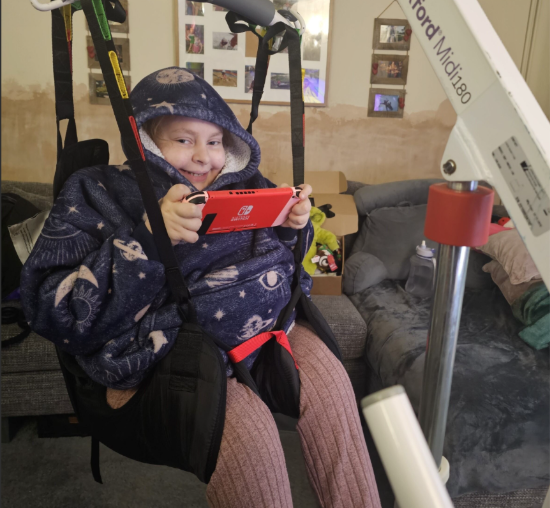
“Day-to-day life involves juggling lots of hospital appoints around school and wheelchair-inclusive activities.
“We’ve just had an unplanned three-week stay at GOSH, and digital is such a great tool in hospital to open up conversations because you’ve got something video or audio to connect with, and it helps to destress these very tense situations.
“Isabella uses her iPad to keep up with school and keep her brain engaged as well as socially to connect with others. She’s immune compromised, so if family or friends have got anything she can’t physically see them, but she can still connect, send jokes and videos.”
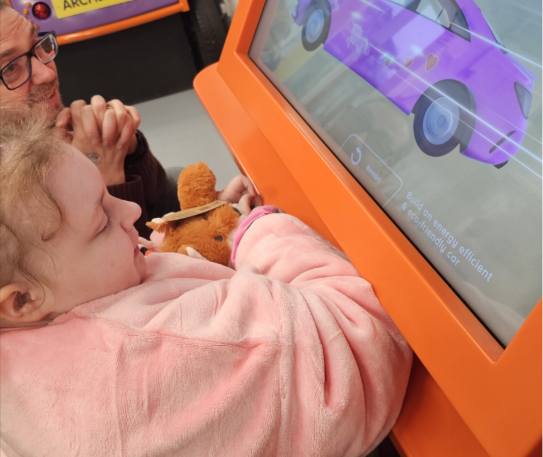
Sarah also tells us how many of Isabella’s interests, such a learning musical instruments electronically, are only available via Apple apps. “The iPad has the majority of SEND apps. We were lucky to receive a grant from Family Fund for it because they are extortionately priced.
“I know people may see a kid staring at a tablet and they think it’s bad – well, actually, no. And particularly for SEN families, I don’t think it’s a bad thing. It’s actually a really useful tool.”
The report follows the first anniversary of the Government’s Digital Inclusion Action Plan in March 2025 which outlines the severe consequences of digital exclusion. With an estimated £24.1 billion of benefits going unclaimed across Great Britain,1 the shift towards digital-first delivery for essential services risks excluding low-income families in particular, who need more support to get online.
Family Fund is part of the Digital Services Consortium and the National Digital Inclusion Network, working to bridge the digital divide in communities across the UK.
The charity’s Discover Digital Support Programme includes the annual Discover Digital summer festival, an accessible three weeks of fun-filled, creative workshops, tailored for disabled or seriously ill children and young people of all ages and abilities and their siblings.
In 2025/26, 19% of all grants provided by Family Fund were for tech items, alongside other essentials for parent carers such as funding for white goods or family breaks.
To read more about Family Fund and its grants and services, visit Family Fund